
Shepherd Center  
menbar
Tour
  of Shepherd Center.
Play Video.
menbar
menbar
Sign Up
To receive our magazine or newsletters.

menbar
menbar
Admissions
  about admissions? Call 404-350-7345 or email:
Heddi Silon
menbar

PATIENT PROFILES

Danielle Boone Danelle Bone

A young nursing student learns what it's like to be the patient during her dramatic recovery from a brain injury

Danelle Bone never thought she'd have trouble recognizing and remembering medical terms. But that changed one day when her routine of working and studying gave way to relearning everything from walking to reading.


Miguel Arriaga Miguel Arriaga

Miguel Arriaga returns to work after a brain injury

Miguel Arriaga looked in the mirror and couldn't believe his eyes. The 21-year-old Atlanta waiter didn't know where he was and didn't recognize his long hair and beard. "I turned and saw my brother," he remembers. "He told me I had been in an accident and that I was in the hospital."


Teal Sherrer Teal Sherer

Adjusting to life in a wheelchair as a young teen

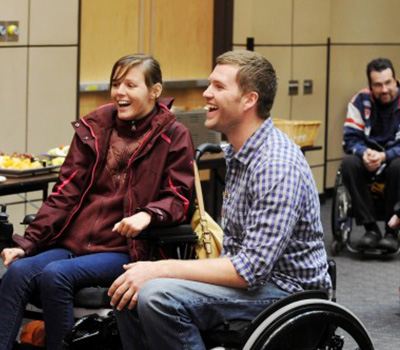
"Friends tell me all the time that they forget I'm in a wheelchair. They just forget," laughs Teal Sherer. "It's all about attitude and personality. No matter what your situation, if you have a great attitude, other people pick up on it."


Jimmy Brooks Jimmy Brooks

Jimmy Brooks relies on technology to live with little assistance

when the phone rings at Jimmy Brooks' home in Montgomery, Alabama, he needs only to say the word "hello" to answer it. The adapted phone is just one example of Jimmy's wide array of assistive technology devices, which, combined with creative problem-solving skills and a state-funded, attendant care program, enables Jimmy to live alone with minimal assistance.


Dwayne Sanders Dwayne Sanders

Dwayne Sanders finds enjoyment and excitement in the sport of handcycling

Dwayne Sanders was "blown away" when he competed in his first-ever handcycling race. Then, in just two years, he went from handcycling neophyte to one of the sport's top racers. He has captured first place in his classification in several races across the nation, earning Dwayne the distinction as one of the nation's reigning champions among quadriplegic handcyclists.


Robbie Clemons Robbie Clemons

Robbie Clemons balances a yearning for independence with a reliance on others

W while his mother inspected a blood-pressure machine at the local Wal-Mart, Robbie Clemons wanted to look at the billiard tables. So Robbie, a quadriplegic who uses a joystick-controlled power wheelchair and relies on a ventilator to breathe, swiveled his chair in the opposite direction and drove off. When his mom, Omerea, turned around and didn't see him -- or hear the telltale whoosh of his life-enabling ventilator -- she became understandably nervous.


Dave Wheeler Dave Wheeler

Family physician returns to his practice following a spinal cord injury

J just hours after a paralyzing motorcycle accident, there was little doubt that Dr. David Wheeler would soon resume practicing medicine again. "Not only was I encouraged to come back to work as soon as possible," he said, "I was expected to come back."


Keith LeClaire Keith LeClaire

Parenting from a wheelchair

As the athletic father of two active young boys, Keith LeClaire spends a lot of time playing games: everything from basketball in the driveway or swimming in the backyard pool, to bicycling through the neighborhood or playing ping-pong in the house. A T-4 complete, Keith has used a wheelchair since he broke his neck in an off-roading accident when he was a teenager. But he can't say his disability interferes with how he and his wife, Amy, parent their children.


Bruce Burton Bruce Burton

The ups and downs of traveling for people who use wheelchairs

A boating mishap paralyzed Bruce from the chest down. But that hasn't stopped him and his wife from taking 10-day jaunts to San Francisco and month-long stays at their lakeside cabin in Canada.


Arthur Willaims Arthur Williams

Returning patients like Arthur Williams to the workplace is integral to Shepherd Center's goal of maximizing independence after a catastrophic injury

Arthur Williams fell from atop a utility pole while performing routine maintenance for his employer, Memphis Power & Light Co. The nearly 20-foot fall paralyzed the divorced father of two from the waist down. He spent the next 11 weeks at Shepherd Center regaining his strength, practicing transfers from his wheelchair to toilets, tubs and chairs, and learning, as he puts it, "how to live everyday life as a paraplegic."


Amanda Bankston Amanda Bankston

Amanda Bankston plans ahead in order to deal with her MS and spend more time with her family

Aaron Howard will sometimes go and get his mother's walker and beg her to come outside with him. The 7-year-old understands his mom's limitations, but he still gently prods. Amanda Bankston, Aaron's mother, a patient of the Multiple Sclerosis Institute at Shepherd Center, will usually comply, maneuvering her walker so she can sit and watch Aaron play. "He gets so sad that I can't do physical things with him," Amanda says. "He once told me, 'I had a dream that you were running with me.'"


Allyson Roth

Alyson Roth

Teacher helps educate the world after a spinal cord injury

Former patient Alyson Roth shares some thoughts on the journey she's had since sustaining a spinal cord injury in a car accident. It's been an intense adventure, she writes.
 

Travis Roy Travis Roy

Travis Roy's "can do" attitude helps raise money for spinal cord injury research

In October of 1995, Travis Roy skated onto the ice for his first game as a college hockey player at Boston University. Eleven seconds later, his career was over. A freak accident left Travis a quadriplegic.


Will Bundy Will Bundy

High school student returns to school after spinal cord injury

Re-entering the workforce after a spinal cord or brain injury is one thing. But what if you had to go back to high school? For many teenagers, returning to school and seeing friends for the first time after the accident is one of the most anticipated milestones of rehabilitation.


Taylor Price Taylor Price

Taylor Price credits his parents for their caregiving following his injury, but the teenager is looking forward to a more independent life as he heads to college.


Matt Conner Matthew Conner

Matthew Conner puts life into perspective after a brain injury

Matthew Conner nearly died in a horrific car accident. He survived eight days in a coma, battled the effects of a severe brain injury and lived for nearly two years with a rod implanted in his shattered leg. Yet despite enduring these and other hardships, Matthew says that as a result of what happened, "I'm a whole lot better than before."


Steven Smith Steven Smith

Steven Smith tackles life with a sense of humor, a smile and a desire to succeed

Figuring out which sport Steven Smith identified with was easy for the sports teams coordinator at Shepherd Center. Steve was a football player through and through. When Steven was admitted to Shepherd, it was the sports team coordinator's job as a sports specialist to find out what sports Steven was involved in so he could link him with a parallel, post-injury adaptive sport.


Danelle Bone

A young nursing student learns what it's like to be the patient during her dramatic recovery from a brain injury

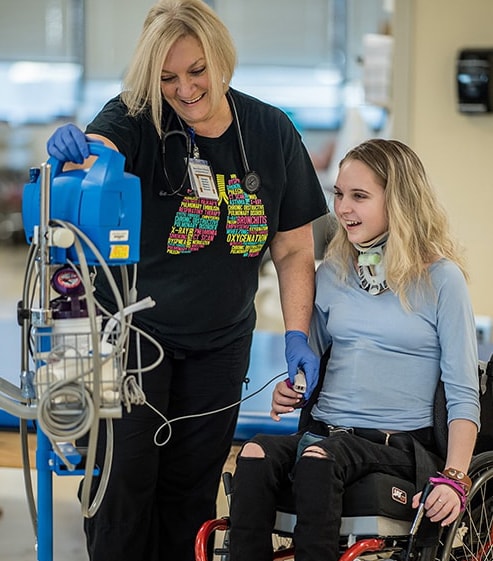
Danelle Bone never thought she'd have trouble recognizing and remembering medical terms. But that changed one day when her routine of working and studying gave way to relearning everything from walking to reading.

While driving to work one day from her parent's home in Atlanta, her sport utility vehicle rolled several times before coming to a stop at a concrete median.

"I don't remember the accident, which is probably good," said Danelle. "I was told that someone stopped from the southbound lane and deflated the airbag so I could breathe. My dog, Maddie, was thrown from the car and over the median wall, and someone else grabbed her."

From the accident scene, Danelle was taken to a nearby hospital, where emergency room doctors found she had fractured bones surrounding her eye sockets, her left hand, and several vertebrae in her neck. Yet more urgently, an MRI revealed that she had sustained a severe blow to her head, causing her brain to swell inside the skull.

A medical team performed an emergency craniotomy to relieve the brain's swelling; a procedure that ultimately saved her life. Danelle spent the next three days in a comatose state and a total of eight days in the hospital's intensive care unit.

Even though her family was overjoyed when Danelle emerged from the coma, no one could predict how the brain injury would ultimately impact her physically or emotionally. It was then that her stepfather began to explore the idea of Shepherd Center, a hospital he knew something about through his friends in the Rotary Club.

Danelle's family decided to transfer her to Shepherd Center, where they hoped she would begin to rehabilitate from the trauma.

Donald Peck Leslie, M.D., led Danelle's rehabilitation team. He described Danelle's injury as severe and cautioned the family that recovery usually takes a long time as the swelling begins to subside and the brain heals.

"Sometimes the brain creates new electrical pathways so that a different part of the brain can take over the injured part," explained Dr. Leslie. "It is difficult to predict how much a particular person will recover from such an injury, and Danelle is no exception. We knew to expect a long waiting game with incremental victories along the way."

Each day, a team of physiatrists, neuropsychologists, and physical, occupational, speech language pathologists and recreational therapists helped Danelle relearn how to stand up, walk, write, remember, concentrate and manage everyday tasks.

"Every day was a struggle," Danelle recalled. "Taking a shower was a huge victory." After three weeks in Shepherd Center, Danelle moved to Shepherd Pathways, the Center's post-acute brain injury treatment facility in Decatur that combines onsite and community-based therapy during the day, while patients commute from home or live on campus. Danelle commuted from her parents' nearby home.

"When I came to Shepherd Pathways, I told my therapists that my two biggest goals were to go back to school and get back on my own, taking care of myself," said Danelle. For two months, she worked with physical therapists to strengthen the left side of her body that was left weak from the injury. They also helped her with balance and walking. Meanwhile, a speech language pathologist showed Danelle how to get back into the high-intensity mode of juggling class work, homework and other day-to-day responsibilities.

"They were constantly quizzing me and asking me to make presentations and write papers so I would be ready for the real thing at school," she said. "It was very tough, but it also made me more motivated to work hard."

As much as the idea of getting back on the highway scared Danelle, she also wanted to start driving again. Like every other 25-year-old, she valued her independence.

After her discharge from Shepherd Pathways, Danelle returned to school and began auditing a few classes. Her instructors worked with her and let her extend a semester's worth of work out through the summer months. Danelle's hard work paid off - she graduated with a bachelor's of science in nursing, and then went on to pass her nursing boards to become a registered nurse.

"Miracles do happen," Danelle said of her dramatic recovery. Today, she and her faithful companion Maddie live in a small house in Atlanta, and she has realized her dream of working in a caring profession.

She still feels the effects of her injury, which are heightened when she is tired. Her gait is sometimes wobbly, and she struggles with math and other complex thoughts, particularly when fatigued. Also she requires at least 10 to 12 hours of sleep each night, time she imagines her body needs to continue to recover.

"When I look back at my time at Shepherd, I am still amazed," said Danelle. "I came to Shepherd having worked in other hospitals, and it was more than I could have expected. The people who cared for me at Shepherd became my friends."

And yes, being a patient changed Danelle's perspective on being a nurse. "It comes up every day at work," said Danelle. "I feel like my sympathy and empathy are heightened, and I can understand and relate to how difficult the day-to-day routine of the hospital can be, particularly for our patients who are hospitalized for a long time.

"Most of all, I can relate to their struggle - that whole world-has-changed struggle once you have experienced a crisis that means you are going to have to completely change your life. But then I remember what I've been through and I tell them: Miracles do happen."

For more information about Shepherd Center's Acquired Brain Injury Program, contact Shepherd Center at 404-352-2020.

Miguel Arriaga

Miguel Arriaga returns to work after a brain injury

Miguel Arriaga looked in the mirror and couldn't believe his eyes. The 21-year-old Atlanta waiter didn't know where he was and didn't recognize his long hair and beard.

"I turned and saw my brother," he remembers. "He told me I had been in an accident and that I was in the hospital."

That was in February 2000 and Miguel didn't know that five weeks had passed since he'd left work, hydroplaned on a rain-slicked road and hit a telephone pole. The impact split the dashboard of his prized 1990 Camero in two. He punctured one lung, tore his colon, lacerated his liver, and broke three vertebrae in his back and one in his neck. Worst of all, he'd been thrown forward with such force his brain was severely injured and he lapsed into a deep coma.

By the time he stood in front of that mirror, Miguel had been undergoing intensive brain injury rehabilitation treatment at Shepherd Center for two weeks.

Today, Miguel spends time with friends, works out at a gym and is back at work six days a week. He has plans to work as an interpreter, and hopes to work with hospital patients who do not speak English.

But things didn't look so bright 18 months ago. After he regained consciousness, Miguel was alert but agitated, what doctors call the Rancho 4 stage. He doesn't remember pulling out his feeding and tracheotomy tubes, trying to hit nurses or becoming angry when friends came to visit.

"He wasn't the Miguel I knew. He was acting like a kid," remembers Shunte Carter, Miguel's fiancée. "Sometimes he would cry and scream. He cursed a lot and yelled, and he'd never done that before."

Not everyone emerging from a coma goes through an agitation phase, but for those who do, doctors look for it to resolve quickly.

"We treat it pharmacologically, provide a safe and highly structured environment and look for signs that the confusion and agitation are clearing," says Donald Peck Leslie, M.D., Medical Director of Shepherd Center and a board-certified physiatrist.

After 29 days in Shepherd's inpatient unit, Miguel transferred to Shepherd Pathways, the Center's post acute brain injury day treatment facility where patients combine onsite and community-based therapy during the day, while commuting from home or living on campus.

"At Shepherd Pathways, we adapt cognitive and physical therapy to the patient's rehab goals," says Jennifer Allred, Miguel's speech therapist. "For Miguel, that meant getting back to work and driving again."

Using a menu from his restaurant, Jennifer made up daily specials which Miguel wrote on a card taped to a file folder "tray." Waiting on fellow patients and therapists, he jotted down their orders as he worked to overcome an auditory memory deficit.

As a waiter, Miguel took pride in memorizing his customers' orders. But now he couldn't remember what he heard, even just 20 seconds later. Although writing down orders worked well for him, memorizing them became one of his biggest goals.

Soon, he was ready for a trial run at Maggiano's. His supervisor gave him one table to wait on and under the watchful eyes of his fellow wait staff and a Shepherd Center job coach, Miguel did great.

At first, he did write down his customers' orders, but not anymore. And, when he gets frustrated or loses his temper, Shunte and his co-workers encourage him to "run around the block" or work out in the gym, which does the trick for Miguel.

For more information about Shepherd Center's Acquired Brain Injury Program, contact Shepherd Center at 404-352-2020.

Teal Sherer

Adjusting to life in a wheelchair as a young teen

Friends tell me all the time that they forget I'm in a wheelchair. They just forget," laughs Teal Sherer. "It's all about attitude and personality. No matter what your situation, if you have a great attitude, other people pick up on it."

Teal is exceptionally well adjusted, but she's the first to explain it wasn't always that way. For her, living with a disability began at age 14 -- an age when most kids are already a little unsure of themselves. Teal was an active teenager living with her parents and younger sister just outside Knoxville, Tennessee. When the car she was in with friends ran off a road, she suffered many internal injuries, but it was a broken L2 vertebra and damaged spinal cord that left her paralyzed from the waist down.

"The first year after the accident was really bad," remembers Teal. "At 14 you want to fit in, and I didn't. I had low self esteem and it was really hard."

Yet, with wisdom beyond her years, she says she realized that everybody in this world faces hardship at one time or another. It was the first bad thing to happen in her life and she chose not to feel sorry for herself.

"I've experienced and learned about something not many people know about," says Teal. "I'm smarter and better for it. You either face life or you sit it out. I didn't want to sit out."

When asked what brought about this revelation for her, she points to several things. For one, there is her family and her mother, who she describes as "the best mother ever." Then, there were her friends. Teal says they've always been amazingly supportive. But, there was one more thing that Teal credits. It is Shepherd Center.

A stranger from Teal's hometown heard about Teal's accident and sought out her parents to suggest Shepherd Center as a rehabilitation facility Teal should consider. The woman had gone to Shepherd for rehabilitation after a stroke. After a visit by Teal's parents, she was transferred there and spent about four weeks undergoing medical treatment and physical rehabilitation.

"The therapy got me on the road to independence, but what's really great at Shepherd is that they literally get you back out there," emphasizes Teal. "You see people who work there using wheelchairs and they all look so great. You see that they're successful and you think, 'Maybe I could do that.'"

And, then there was the peer support. While at Shepherd, Teal was introduced to a girl who was a few years older than her. She, too, was a cheerleader who had been injured and needed a wheelchair. Teal related to her and saw a beautiful, successful person who drove a sports car and had a boyfriend. They've kept in touch over the years. Teal has called her with questions about getting around, social life, buying a car equipped for her needs and more. Now, Teal returns the favor by visiting Shepherd as a peer supporter herself.

Teal is able to visit Shepherd often because she chose Oglethorpe University in Atlanta for her college education. When she was deciding on colleges, Teal was a little nervous about leaving home and some of her old fears came back.

"What if I needed a part on my wheelchair or a place to work out or for therapy," she wondered. "So, I chose Atlanta for school because I knew Shepherd was there if I needed anything. I just feel safe having them nearby."

For more information about Shepherd Center's Spinal Cord Injury Program, contact Shepherd Center at 404-352-2020.

Jimmy Brooks

Jimmy Brooks relies on technology to live with little assistance

When the phone rings at Jimmy Brooks' home in Montgomery, Alabama, he needs only to say the word "hello" to answer it. The adapted phone is just one example of Jimmy's wide array of assistive technology devices, which, combined with creative problem-solving skills and a state-funded, attendant care program, enables Jimmy to live alone with minimal assistance.

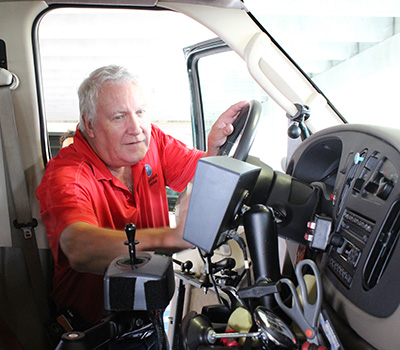
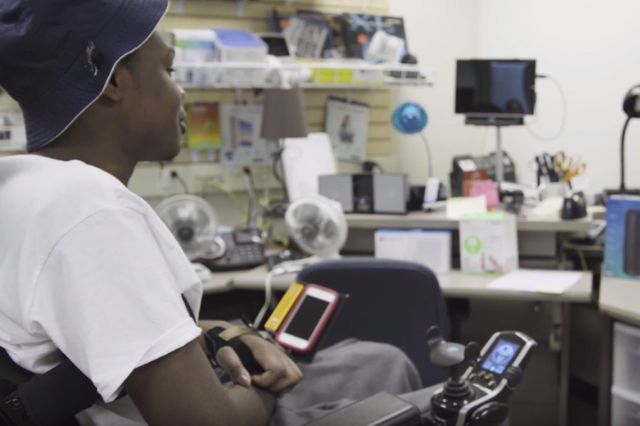
Assistive technology devices are essential to Jimmy's lifestyle. He gets around in a joystick-controlled power wheelchair and relies on friends to drive him in his lift-equipped van. He uses the latest voice-recognition software to surf the Internet and send e-mail, and controls everything from the temperature of his apartment to the channels on his television with mouthstick-operated remote control units. "All these little gadgets," he says, "make it possible for me to live on my own."

Most of these technological tools were introduced to Jimmy during his six-week stay at Shepherd Center, where his medical rehabilitation focused on improving range of motion in his arms, toning key muscles and exploring ways in which technology could extend his abilities. This last task fell to Ruth Fierman, occupational therapist and Shepherd's Assistive Technology Coordinator. "Assistive technology," Ruth explains, "can give you back some of the abilities that were lost after your injury."

Jimmy credits Ruth with sparking his interest in the assortment of high-tech helpers that are now indispensable to his daily life. "Her class was certainly one I never wanted to miss." Before his injury, Jimmy never needed to be so resourceful. A professional safecracker, Jimmy held partial ownership in a local locksmith company and enjoyed an adventurous and relatively carefree lifestyle. He was an avid skydiver, snowskier and scuba-diver, played enough golf to whittle his handicap down to a 15, and relished any opportunity to hunt deer.

It was while hunting deer on 300 acres of prime hunting land in Montgomery that Jimmy's life took a fateful turn. As dusk approached, Jimmy silently awaited his prey on a 16-foot high deer stand. He was looking forward to closing out two long days of hunting by sharing a meal of Cornish game hen with friends, then watching the annual Auburn-Alabama football rivalry on television. Instead, he dozed off and toppled out of the stand.

His injuries included a broken neck and broken left wrist. Once extricated from the woods in a four-wheel-drive pickup, Jimmy spent three weeks in a Montgomery hospital before transferring to Shepherd Center for rehabilitation therapy.

Before his injury, Jimmy had spent many hours around people with spinal cord injuries. His nephew has been quadriplegic since a teenage bicycling accident, and as a skydiving jumpmaster, Jimmy led jumps of two dozen people with spinal cord injuries over the years.

None of those experiences, however, prepared him for his own paralysis, he says. After his injury, he sank into a depression that didn't lift until after he left Shepherd. "I was not the most motivated patient," says Jimmy, who nonetheless speaks glowingly of the hospital and its staff. "The steps they take in training an individual are very impressive. The information they send you home with is extremely helpful."

Now accustomed to living alone, Jimmy has set his sights on returning to productive work and leisure activities. He plans to take computer classes in hopes of becoming a software troubleshooter, and wants to hunt again before the season ends. His van or trailer can get him into the woods, and a friend currently is designing an adaptive rig for his rifle. "Once that's set up," Jimmy says confidently, "I'll be good to go."

For more information about Shepherd Center's Assistive Technology Program, contact Shepherd Center at 404-352-2020.

Dwayne Sanders

Dwayne Sanders finds enjoyment and excitement in the sport of handcycling

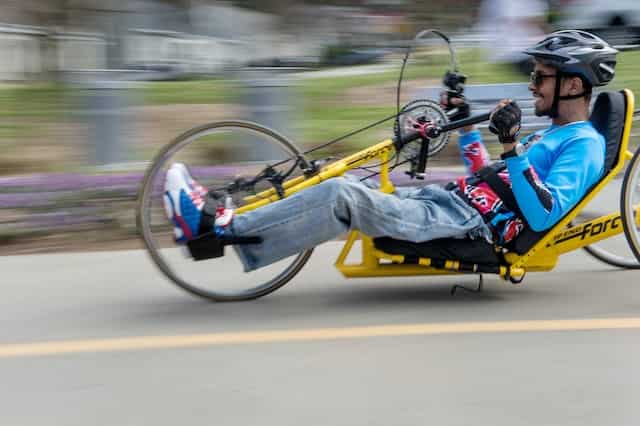
Dwayne Sanders was "blown away" when he competed in his first-ever handcycling race. Then, in just two years, he went from handcycling neophyte to one of the sport's top racers. He has captured first place in his classification in several races across the nation, earning Dwayne the distinction as one of the nation's reigning champions among quadriplegic handcyclists.

Dwayne is no stranger to the thrill of competitive athletics. He was a two-sport athlete at Henderson High School in DeKalb County, Georgia, and was a cheerleader at Georgia Tech when he fell and injured his spinal cord. The accident preceded a Tech football game at Duke University. Dwayne over rotated on one of his practice flips off a mini-trampoline, landed head-first and broke his sixth cervical vertebra in three places.

After receiving initial treatment at a nearby medical center, Dwayne was transferred to Shepherd Center. He spent three months enduring what he calls "tough love" treatment, as therapists helped him regain enough strength and mobility to dress, eat, shower and perform other activities of daily living with his disability.

"I learned how to take care of myself there," he recalls.

Shepherd's teachings were "integral" in allowing him to return to college, Dwayne says. He reenrolled at Georgia Tech the following spring and moved back into his fraternity house on campus, which he negotiated using a power wheelchair. He graduated with a bachelor's degree in chemical engineering.

In the years following his injury, Dwayne dabbled a bit in disabled sports-racing wheelchairs, lifting weights and participating in some field events such as shot put and discus-but took none too seriously. He rekindled his interest in sports, when, he says, working from home as an emissions-control engineer put him "too close to the cookie jar," and he was looking to shed some pounds through recreation and exercise.

He found that handcycling exceeded those initial goals. He did gain upper-body strength, lose fat and get in better cardiovascular shape. What's more, he rediscovered a classic family activity: taking a leisurely bike ride around the neighborhood. "I found something the family can all do together," says Dwayne, who has two kids with his wife, Sharon. "Although they laugh at me and say it used to be more fun when I wasn't so fast."

For more information about Shepherd Center's Sports Teams, contact Shepherd Center at 404-352-2020.

Robbie Clemons

Robbie Clemons balances a yearning for independence with a reliance on others

While his mother inspected a blood-pressure machine at the local Wal-Mart, 15-year-old Robbie Clemons wanted to look at the billiard tables. So Robbie, a quadriplegic who uses a joystick-controlled power wheelchair and relies on a ventilator to breathe, swiveled his chair in the opposite direction and drove off. When his mom, Omerea, turned around and didn't see him -- or hear the telltale whoosh of his life-enabling ventilator -- she became understandably nervous.

Omerea raised quite a commotion once she finally tracked him down, Robbie says. Her fear: at a moment's notice, Robbie could face a life-threatening scenario -- such as his ventilator tube popping off or a cough forcing phlegm into his windpipe. Both situations, if not resolved quickly, could endanger his life.

"You just kind of worry," she explains, "because very few people would know what to do if something happened."

The incident symbolizes the challenge faced by Robbie and others his age who are coping with high-level spinal cord injuries. As teenagers, they yearn for independence, but at the same time they are heavily reliant on others to help them perform many of life's most basic functions.

Robbie's reliance on caregivers stems from a C2-3 incomplete spinal cord injury sustained during a mishap in his hometown of Florence, South Carolina. Although he doesn't remember it, he fell off the back of his dad's pickup truck and got caught under the trailer behind it.

Robbie's condition requires nearly full-time assistance. He wakes daily at 6 a.m., and spends the next hour and 15 minutes with someone -- his mom, stepmom or dad, usually -- preparing for the day. On weekdays, a small lift-equipped bus picks him up and drives him to school, where a full-time nurse accompanies him to classes and takes notes for him. After nearly a full day of classes and study halls -- where he takes tests by verbally stating his answers to an aide -- he leaves 10 minutes before the final bell to avoid the end-of-day rush.

Despite the almost round-the-clock care he receives, Robbie is determined to maximize his freedoms. He exploits every opportunity he can to spend a few moments alone or with friends.

He uses voice-recognition software and a laptop computer to e-mail friends -- including several he met at Shepherd Center -- and surf the web alone in his bedroom. "Being on the computer gives me a sense of freedom," he says, "because I don't have to ask someone to do everything for me."

For more information about Shepherd Center's Spinal Cord Injury Program, contact Shepherd Center at 404-352-2020.

Dave Wheeler

Family physician returns to his practice following a spinal cord injury

Just hours after a paralyzing motorcycle accident, there was little doubt that Dr. David Wheeler would soon resume practicing medicine again. "Not only was I encouraged to come back to work as soon as possible," he said, "I was expected to come back."

Dave's wife Patti, also a doctor, encouraged him as well. "She was very instrumental in my early return to patient care responsibilities and an active lifestyle," he says.

Within six weeks of discharge from Shepherd Center, Dave did return to work, aided only by a few modest adjustments to his worksite and to his routine. Today, as a paraplegic with no feeling or movement below his armpits, David is again one of the few family physicians serving his rural mountain community of Cashiers, North Carolina. He's also resumed regular rotations as an emergency room physician at the local hospital.

Dave says the adjustment hasn't been particularly difficult for him or his patients. They are comfortable or even inspired by his condition, a result he sees as "an opportunity to affect people, to minister to people, in a way that wasn't possible before I got hurt."

Dave, a native of eastern Kentucky, had been a family practice physician in Cashiers for 11 years at the time of his injury. When his injury occurred, Dave had crashed a friend's motorcycle into a mountainside while riding along a twisting road. When he regained consciousness minutes later, he was unable to sense how his body was positioned or feel his fingers. At that point, Dave says, "I started thinking about life in a wheelchair."

When he arrived at Shepherd Center a week later, Dave's rehabilitation was initially slowed by his still-healing shoulder bone, which effectively immobilized his left arm and forced him to use a power wheelchair. During that time, he battled blood pressure so low he couldn't sit upright without passing out, upper-back pain and muscle spasms.

When his shoulder bone finally healed, Dave's rehab "took off." He began using a manual wheelchair, lifting arm weights, stretching, transferring in and out of his wheelchair and learning about personal care tasks such as bowel and bladder treatments. The encouragement and skills training provided by Center staff, Dave says, prepared him as much as possible for returning home. When he departed in late October, "I was comfortable that I could be relatively independent."

Back at work, Dave was initially apprehensive about how patients would receive his paralysis. Would they, for instance, hold back from reporting problems with their legs, knees or feet, knowing Dave couldn't even move his? The only changes Dave has detected, however, have been positive. "I do think often times that my patients are inspired to get out and exercise or take better care of themselves," he says, "to some extent because they see me doing that, and I perhaps have more significant issues."

This new wrinkle in his doctor-patient relationships fits Dave's healing approach. One of the reasons he became a doctor was to teach people about their medical conditions in a way that encourages better self-care. "I enjoy taking time to explain and teach patients about their health," he says. His attention to his own health as a paraplegic only amplifies his message.

For more information about Shepherd Center's Spinal Cord Injury Program, contact Shepherd Center at 404-352-2020.

Keith LeClaire

Parenting from a wheelchair

As the athletic father of two active young boys, Keith LeClaire spends a lot of time playing games: everything from basketball in the driveway or swimming in the backyard pool, to bicycling through the neighborhood or playing ping-pong in the house. A T-4 complete, Keith has used a wheelchair since he broke his neck in an off-roading accident when he was a teenager. But he can't say his disability interferes with how he and his wife, Amy, parent their children.

Keith does miss some of the physical joys of fatherhood. He's an avid cyclist and wheelchair tennis player, but still wishes he could toss his boys into the air, lift them onto his shoulders or take them father-and-son camping in the wilderness. Everyday parenting is a challenge, he admits, but no more so because he's in a wheelchair. "I just don't think it's any harder," says Keith. "A lot of it is verbal. Discipline and guidance isn't any harder. If one of them runs away, there are going to be consequences, no matter if I'm in a chair or not."

In fact, people with SCI who have kids report few limitations to parenting. For the most part, they share the same thrills, anxieties and challenges in child-rearing as any able-bodied parent. Sure, they may need to build a custom-made changing table or be especially firm when it comes to safety, but such obstacles usually don't pose any challenge that some combination of adaptive equipment and human ingenuity can't conquer.

LeClaire is looking forward to seeing his sons grow and mature. As they age, Keith, who teaches disability awareness and safety at Gwinnett County middle schools in suburban Atlanta about three days each week, sometimes finds himself needing to explain his disability. "When Colton pushes me, for instance, I tell him daddy doesn't like to be pushed because I don't want to lose my balance."

Parenting is one of those challenges, he says, one that "helps you grow, and builds character. It's one of the most rewarding things I've ever done." Few parents, whether disabled or able-bodied, would disagree.

For more information about Shepherd Center's Spinal Cord Injury Program, contact Shepherd Center at 404-352-2020.

Bruce Burton

The ups and downs of traveling for people who use wheelchairs

"When it comes to traveling in a wheelchair, the first time is always the toughest," says Bruce Burton. "After that, you can take on anything."

A boating mishap paralyzed Bruce Burton of Stone Mountain, Ga., from the chest down. But that hasn't stopped him and his wife, Marcia Pauly, from taking 10-day jaunts to San Francisco and month-long stays at their lakeside cabin in Ontario, Canada. Their first trip after Burton's injury, however, was only four days long - a visit to Pauly's sister in Albuquerque, N.M.

"In order to see if we could take longer trips, we wanted to start out with a shorter trip to see what it was like," Burton said. The couple planned in detail, making endless lists of medicines and supplies, copying prescriptions and arranging rentals of hoyer lifts and vans. Despite their thoroughness, there were unforeseen problems. For instance, because they feared the airlines would damage Burton's power chair, they left it at home. That overburdened Pauly and her brother-in-law, who had to push Burton in his manual chair and lift him in and out of the rental van, which wasn't lift-equipped.

But the lessons learned on that first trip allowed them to plan more ambitiously. "That whole trip was our shakedown," Pauly said. Last summer the couple drove 1,200 miles to a one-room cabin on an island in Canada's Georgian Bay. The cabin has been in Burton's family for 55 years, and his brother was determined to modify it so Burton could continue his annual visits.

Making the cabin accessible required some creative problem-solving, such as installing a cherry picker on the dock to transfer Burton from the boat to the shore, a propane-generated trolley to carry him up the smooth rock surface to his cabin and an old public bus lift so Burton could wheel onto the outside deck, which was a few feet lower than the rest of the house. During his stay, Burton enjoyed spending time fishing, boating, stargazing and visiting with friends and family. "It was wonderful," he said.

Last October, the couple took their second post-injury trip to San Francisco, home to two of their children and 15-month granddaughter. They relied solely on public transit and walking/wheeling to get around the city.

"San Francisco is like a dream city for someone in a wheelchair," said Burton, who crossed the Golden Gate Bridge in his wheelchair, visited Fisherman's Wharf and shopped at Embarcadero Center. Except for the fabled cable cars, he said, "we were able to go everywhere we wanted to go."

Without the confidence gained from that chaotic first trip to Albuquerque, spending 10 days in San Francisco might have been too much to bear. The couple plans to return to San Francisco and Canada this year, and to maybe visit their 26-year-old daughter in New York. Pauly's advice: "Start small and do something a little familiar."

"Then you can take on anything," Burton said.

For more information about Shepherd Center's Spinal Cord Injury Program, contact Shepherd Center at 404-352-2020.

Arthur Williams

Returning patients like Arthur Williams to the workplace is integral to Shepherd Center's goal of maximizing independence after a catastrophic injury

Arthur Williams fell from atop a utility pole while performing routine maintenance for his employer, Memphis Power & Light Co. The nearly 20-foot fall paralyzed the divorced father of two from the waist down. He spent the next 11 weeks at Shepherd Center regaining his strength, practicing transfers from his wheelchair to toilets, tubs and chairs, and learning, as he puts it, "how to live everyday life as a paraplegic."

For the previous seven years, a big part of Arthur's everyday life was his job as a power-company lineman. A man of strong faith, the 30-year-old says he wasn't concerned with his chances of resuming his career. After all, as a newly injured T-12 paraplegic his primary focus was absorbing "a different way to do things, from cooking to putting my 3-year-old son in the tub." But he admits that the following spring, rejoining his colleagues on a temporary desk assignment provided an emotional lift. "I got sick of sitting around," he shrugs.

Returning adult patients like Arthur to the workplace is integral to Shepherd Center's goal of maximizing independence after a catastrophic injury. The research is clear: people with disabilities who are employed enjoy greater life satisfaction, higher activity levels and better overall health than those without work. To get back on the job, patients who've experienced catastrophic injuries need access during and after rehabilitation to a broad continuum of care and individualized services in physical and cognitive therapies, vocational counseling, transportation management, assistive technology, home modification, among others.

Williams worked briefly with Shepherd Center vocational specialists to identify some transferable skills, and when he returned to work, he gladly filled a new office post carved out by his old supervisors: assuming much of the clerical duties from his former field colleagues. Recently, he says, "I've been looking throughout the company, searching for what I'd be interested in doing." He will likely go to school for an associate's or bachelor's degree, then return to the work world - just like most everyone else.

For more information about Shepherd Center's Spinal Cord Injury Program, contact Shepherd Center at 404-352-2020.

Amanda Bankston

Amanda Bankston plans ahead in order to deal with her MS and spend more time with her family

Aaron Howard will sometimes go and get his mother's walker and beg her to come outside with him. The 7-year-old understands his mom's limitations, but he still gently prods. Amanda Bankston, Aaron's mother, a patient of the Multiple Sclerosis Institute at Shepherd Center, will usually comply, maneuvering her walker so she can sit and watch Aaron play. "He gets so sad that I can't do physical things with him," Amanda says. "He once told me, 'I had a dream that you were running with me.'"

Fatigue, heat sensitivity, dizziness and impaired cognition are just a few of the symptoms of MS, an insidious autoimmune disease. Amanda, a single mother who also has 13-year-old twin daughters, has had the disease since 1997. Like other parents diagnosed with MS, she must find ways to conserve energy, so she can be there for her children when they need her most. She lives with her parents to provide support, and friends and other family members often drive her children to places they need to be.

Amanda says that lacking energy and being tired all the time is a major characteristic of the disease, which makes caring for young children especially difficult. As a result, she plans ahead. Amanda tries to nap while her children are in school so that she has energy when they come home. "I want them to know I'm here," Amanda says, "and that I can still help them with their homework."

She says it is important to educate children on the disease and its limitations, so they understand what is going on. Amanda also realizes the importance of asking for help, which can be difficult.

"You can see why pride is a sin," says Amanda. "I was pretty self-sufficient before I got sick. You have to check your pride and admit you need help."

For more information about Shepherd Center's Multiple Sclerosis Program, contact Shepherd Center at 404-352-2020.

Alyson Roth

Teacher helps educate the world after a spinal cord injury

to sum up the past five years in a short biography doesn't even begin to shed light onto the intense adventure I have had since my car accident. Hopefully this will allow you to peak into parts of my journey.

The summer of 2000 was a wonderful time in my life as I spent my summer break from college working in Yosemite National Park. I spent the days hiking in the mountains, camping, swimming and riding my bike. As summer came to an end, I packed my car up with all my belongings and headed back to Georgia with a friend of mine. Little did I know that my life would change in a few short hours.

The car tire caught the edge of the road, which threw the car into a tailspin and eventually hurled it into the air like a basketball. Even though I was wearing my seatbelt, my car seat was slightly reclined and this somehow caused me to exit the car. My friend got out of the car and came rushing to my side. I was air lifted to the hospital where I later found out that I had endured a complete spinal cord injury at the T8 level.

The journey that I was about to embark on was not going to stop me from doing what I loved such as traveling, teaching and playing the violin. At Shepherd Center, I learned how to take care of my daily living needs, such as dressing myself, exercising and driving. I also learned how to deal with the things that I used to take for granted. Shepherd Center taught me how to live my life and still have fun and be an independent woman with this permanent disability.

Since the accident, I've had several opportunities around the country to speak to various groups not only about the impact of having a disability, but also to shed light on some myths that people seem to associate with being disabled. I have had the unique privilege to travel to Nicaragua, a third-world country, and help rebuild a community that was wiped out by a hurricane. I was also given the chance to visit an orphanage for children with disabilities and brighten those children's day. I'm a teacher by profession, so each day I am able to educate children not only in academics, but I also give them the opportunity to broaden their horizons as they interact with someone unlike their able-bodied self. I have truly been blessed by their curiosity and wonder.

Without the help of Shepherd Center, I would not be at the point I am today. They have given me a sense of purpose and have taught me the tools to be a successful young woman in society.

For more information about Shepherd Center's Spinal Cord Injury Program, contact Shepherd Center at 404-352-2020.

Travis Roy

Travis Roy's "can do" attitude helps raise money for spinal cord injury research

Travis Roy is in a good place. The peace and beauty of his family retreat in Lake Champlain, Vermont give him a chance to go pontoon boating with his giggling nieces and nephew, a chance to unwind, and now, a chance to reflect on the ten years that have passed since the day his life changed forever.

In October of 1995, Travis Roy skated onto the ice for his first game as a college hockey player at Boston University. Eleven seconds later, his career was over. A freak accident left Travis a quadriplegic.

Now, more than a decade later, Travis is driven by the same courage he needed on the ice, the same courage he needed to rebuild his life. But for all of the positive energy Travis applies to his daily life, he is deflated by the long wait for the technology that will allow him and others to walk again. He never thought he would wait this long, not ten years, certainly not another ten. "As a quadriplegic," Travis says, "the thing I crave is independence." It's not the idea of skating again that drives him, it's the idea of being able to do simple things for himself.

Travis does far more than simple things in his work. He does extraordinary things. Travis is a motivational speaker, inspiring people, not just with his own story, but with what he has learned are the important things in life: letting people know you love them; being proud of who you are; and reaching your goals by focusing on what you can do - not on what you can't. It's that "can do" attitude that led to the birth of the Travis Roy Foundation, an organization that helps people stricken with spinal cord injury and raises money for research and treatment.

After his accident, Travis spent eight weeks at Shepherd Center. He says he only wishes the unmatched care he received at Shepherd was available everywhere. With more funding, more research and, someday, the cure, it may just happen. For now, Travis Roy says waiting is tempered by one overriding lesson, "live life now."

To find out more about the Travis Roy Foundation, log onto www.travisroyfoundation.org.

For more information about Shepherd Center's Spinal Cord Injury Program, contact Shepherd Center at 404-352-2020.

Will Bundy

High school student returns to school after spinal cord injury

re-entering the workforce after a spinal cord or brain injury is one thing. But what if you had to go back to high school? For many teenagers, returning to school and seeing friends for the first time after the accident is one of the most anticipated milestones of rehabilitation.

In addition to the physical challenges, the emotional obstacles are difficult. A lot has changed. The inevitable questions and awkward exchanges aren't easy. And what were once mundane activities like catching the bus, navigating the lunch line and getting from one classroom to the next now requires a lot of ingenuity.

One teen, Will Bundy, returned to school in Nashville, Tenn. earlier this year after spending a month at Shepherd Center rehabilitating from a bicycle accident.

Shepherd helps teens make the transition back to school as smooth as possible as part of the adolescent rehabilitation program. As the discharge date draws near, a team of therapists who specialize in adolescent care works with the patient and family to design the best plan that will help ease the transition.

In some cases, a Shepherd therapist will make arrangements with the school and accompany teens on their first day back to talk to students and staff. Depending on what the patient prefers, the therapist might talk to a class about the injury so they have a better understanding of what happened. The presentation might cover medical issues that could arise during the school day and what everyone can do to be prepared.

Therapists also give teachers and staff an opportunity to meet one-on-one to ask any questions or voice concerns. Teen patients usually choose whether a presentation is made to a select group at school or to the entire student body and staff.

Bundy, a high-school junior, and his family decided they wanted to gather the entire student body and faculty together for his return to school.

Students in the audience got a chance to ask questions, which ran the gamut, ranging from light-hearted but honest - "How do you use the brakes if you're going too fast?" - to more serious questions that dealt with stem-cell research and its potential benefits for people with spinal cord injuries.

Each year Shepherd's adolescent program helps more than 100 teenagers like Bundy return to their schools, most within four months of their paralyzing injury. To provide another aid for teens before and after the transition, Shepherd also produced an informational pamphlet called, "Going Back to School: A Guide for Recently-Injured Teens." The guide is written specifically for teens, but is useful for parents, teachers, school administrators and health professionals.

For more information about Shepherd Center's Adolescent Program for teens with spinal cord injuries, contact Shepherd Center at 404-352-2020.

Taylor Price

Taylor Price credits his parents for their caregiving following his injury, but the teenager is looking forward to a more independent life as he heads to college a diving accident not only paralyzed Taylor Price from the chest down, it also postponed a much-anticipated rite of passage: heading off to college.

Instead of joining numerous friends in Georgetown University's freshman class, Taylor deferred his acceptance and decided to remain with his parents and his sister in Ridgewood, NJ, following his discharge from Shepherd Center.

Taylor, who has a C5-level spinal cord injury, requires assistance in getting in and out of bed, dressing and undressing, showering, preparing meals, going to the bathroom, and transferring in and out of his wheelchair. Despite a daytime caregiver, much of the load falls on his parents, Marnie and Willy. They are also the ones who get up at night to reposition Taylor if his legs spasm.

"It's not easy," says Willy, adding in the same breath that he is happy to care for the son he loves. Taylor says he appreciates his parents' vital assistance, but acknowledges that at age 19, "the last thing you want is your parents taking care of you."

Taylor says he has had to assert his independence at times, and credits his parents with giving him more space as of late. "As a parent, you tend to want to shower your children with as much love and affection as you can," says Willy, "and in a situation like this you probably coddle them more than you should."

Taylor's looming departure for college has his parents "excited but very nervous," says Willy. He wants Taylor to rejoin his peers but worries about breakdowns in care that could lead to a medical emergency. The family is in the process of hiring a full-time caregiver -- preferably a male in his mid-20s - who will reside in an adjoining suite in Taylor's Georgetown dorm.

Taylor is hopeful that his departure will restore some separation between parenting and caregiving. But, he is already wise enough to muse aloud that it does not matter if you can or can't walk, "your parents will always want to take care of you."

For more information about Shepherd Center's Spinal Cord Injury Program, contact Shepherd Center at 404-352-2020.

Matthew Conner

Matthew Conner puts life into perspective after a brain injury

Matthew Conner nearly died in a horrific car accident. He survived eight days in a coma, battled the effects of a severe brain injury and lived for nearly two years with a rod implanted in his shattered leg. Yet despite enduring these and other hardships, Matthew says that as a result of what happened, "I'm a whole lot better than before."

Why? For starters, the ordeal left Matthew's caring and amiable personality intact, and he has recovered enough to resume a typical teenage lifestyle: he's a graduating senior planning for college, plays two sports, bags groceries for an after school job, and in his free time enjoys lifting weights and hanging out with his girlfriend.

But beyond those signs of restored normalcy, Matthew has regained a reverence for life. On the day of his accident, he was off-roading along a dirt trail. As the trail wound its way down a hill and around a blind turn, it intersected a busy state highway, where a truck traveling about 55 miles per hour knocked Matthew, who wasn't wearing a helmet, 20 feet from the vehicle. At that point, no one was sure whether he would live or die.

Matthew lay in a coma for three weeks. Doctors put him on a ventilator, inserted an intracranial pressure monitor into his skull and a rod into the thigh of his shattered right leg, and placed an external fixator on his calf. He underwent surgery to mend his broken jaw and replace two teeth. And then Matthew's family waited while doctors and nurses treated the hemorrhage and swelling in his brain's parietal and occipital lobes caused by the impact of the collision. On the eighth day, he partially opened one eye.

Matthew emerged from his coma over several days in a Memphis hospital, starting with moving his fingers and then tracking movements with his eyes for a few seconds. Sixteen days after his accident he was able to give his nurse a high five, follow simple commands, sit up in a chair and stay awake for up to two-and-a-half hours. But he remained agitated and sometimes pulled at his IV tubes and rubbed his injured leg.

Matthew's mother, Nancy, made the decision to transfer Matthew to Shepherd Center. She said the decision was prompted by the advice of hospital doctors and family members researching brain injury rehabilitation programs, and by a visit from Shepherd Center clinical evaluator Perry Ann Williams. "I was impressed she would travel to Memphis to meet with us," says Nancy.

When he arrived at Shepherd Center, Matthew's jaw was wired shut, and he was restless, frequently distracted and easily irritated, the hallmarks of a Rancho 4 level of consciousness. "Patients in this stage are significantly agitated because their brains are still waking up," says physiatrist Gerald S. Bilsky, MD, Matthew's physician at Shepherd Center. "They see things happening around them but aren't able to process the information or respond to the stimuli. For many patients, though, it's just a phase."

Matthew's treatment included behavioral interventions, medications and the least restrictive environment possible to help him progress. He also needed prompting to follow even one-step directions, says his speech therapist, Karen Patterson.

Karen worked with Matthew to improve his voice quality and increase his attention span, among other things. The two often worked in a quiet room with few distractions. "Our job is to retrain people to do what they need to do to be independent," says Karen. For patients who need continual cues to perform even the most basic tasks, she adds, "even things like brushing your teeth or getting dressed become a therapy activity."

Mathew's mother, who works at an assistive technology center for people with disabilities in Tennessee, credits Shepherd Center for giving Matthew the coping skills he needs to deal with lingering problems like memory deficits. "Without the skills the therapists gave him there, he wouldn't be doing as well as he is. They pushed him and pushed him physically so when his mind was ready, his body was ready."

Four weeks after arriving at Shepherd Center, Matthew could follow routine directions, display appropriate behavior in his responses, and demonstrate that he was oriented to his situation. "He met all the goals we set for him upon admission," says Karen. "He worked hard and made a lot of progress in a short period of time."

Matthew's rehabilitation continued in Shepherd's day program, where he worked for two-and-a-half months on insight, judgment and reasoning skills. During that time, Nancy and her parents remained involved in Matthew's rehabilitation and stayed at Shepherd Place, a 12-unit apartment complex for out-of-town day program patients and family members. "Shepherd Center helped pull us through a very difficult time," she says.

Two-and-a-half years after his injury, Matthew still has some memory problems and says it sometimes takes a little longer to find the right words or to process situations. And although he's also as strong (his bench press is back to 245 pounds) and as fleet-footed as before, his coordination and reaction time are now a bit slower than they used to be.

Says his mom, "He realizes that life is important. God gave him another chance."

His positive experience with therapists at Shepherd Center and the benefits he reaped from therapy have made him consider joining the profession. Matthew is currently looking into a two-year program for physical therapy assistants at his local community college. "I figure I had to go through it for so long that I already know a lot about it," he says. His patients would surely be inspired by his story.

For more information about Shepherd Center's Acquired Brain Injury Program, contact Shepherd Center at 404-352-2020.

Steven Smith

Steven Smith tackles life with a sense of humor, a smile and a desire to succeed

For Shepherd sports team coordinator Bob Baird, figuring out which sport Steven Smith identified with was easy. He was a football player through and through.

When Steven was admitted to Shepherd Center, it was Bob's job as a sports specialist to find out what sports Steven was involved in so he could link him with a parallel, post-injury adaptive sport. For example, he says, "Runners typically like wheelchair racing, while football players go for rugby."

On the night he was injured, Steven was a 16-year-old high school senior at Keith High School in Orrville, Alabama, a small town near Selma. On this particular evening, Steven, a running back, was playing guard for the varsity football team and his school was ahead.

A tackle at the beginning of the second quarter broke Steven's neck, rendering him quadriplegic. Of the accident and the injury, Steven says, "I knew what was wrong. My uncle got hurt playing football - he was recovering a fumble and someone fell on his neck. His injury was higher, but I knew that it was the same thing."

After undergoing surgery to fuse his C5 and C6 vertebrae at Baptist Hospital in Montgomery, Alabama, Steven transferred to Shepherd Center for acute rehabilitation and medical care. He was paralyzed from the chest down, with limited movement in his arms and hands.

At Shepherd Center, Steven quickly bonded with Bob, who explains that inpatients at Shepherd are encouraged to start sports as soon as they are emotionally and physically ready. "Steven - that guy was ready to go immediately," he recalls. "He was great to work with. Every time I'd transfer him from his wheelchair and he'd have his arms wrapped around my head, he'd give me a noogie!"

Bob believes Shepherd's adapted sports program was particularly beneficial to Steven. "He identified himself as an athlete, and we showed him he can still be one."

"I like rugby because you can knock people out of their [wheel]chair," Steven says. He appreciates wheelchair hockey for the same reason, but adds, "I had to hold my stick in one hand, so I couldn't push [my wheelchair] as hard."

After leaving Shepherd, Steven returned to high school and graduated with his class the following spring. "He's a smart little rascal," Mattie says. "His teachers brought work to him. Coach Hurt even went all the way to Atlanta to bring work to him. He didn't get behind, so he was ready when school started back in January."

Following graduation, Steven moved to Detroit to live with his mother and to go to college. He attends classes four days a week at Wayne State University, where he is studying biology and looking forward to a future in forensics.

For more information about Shepherd Center's Spinal Cord Injury Program, contact Shepherd Center at 404-352-2020.